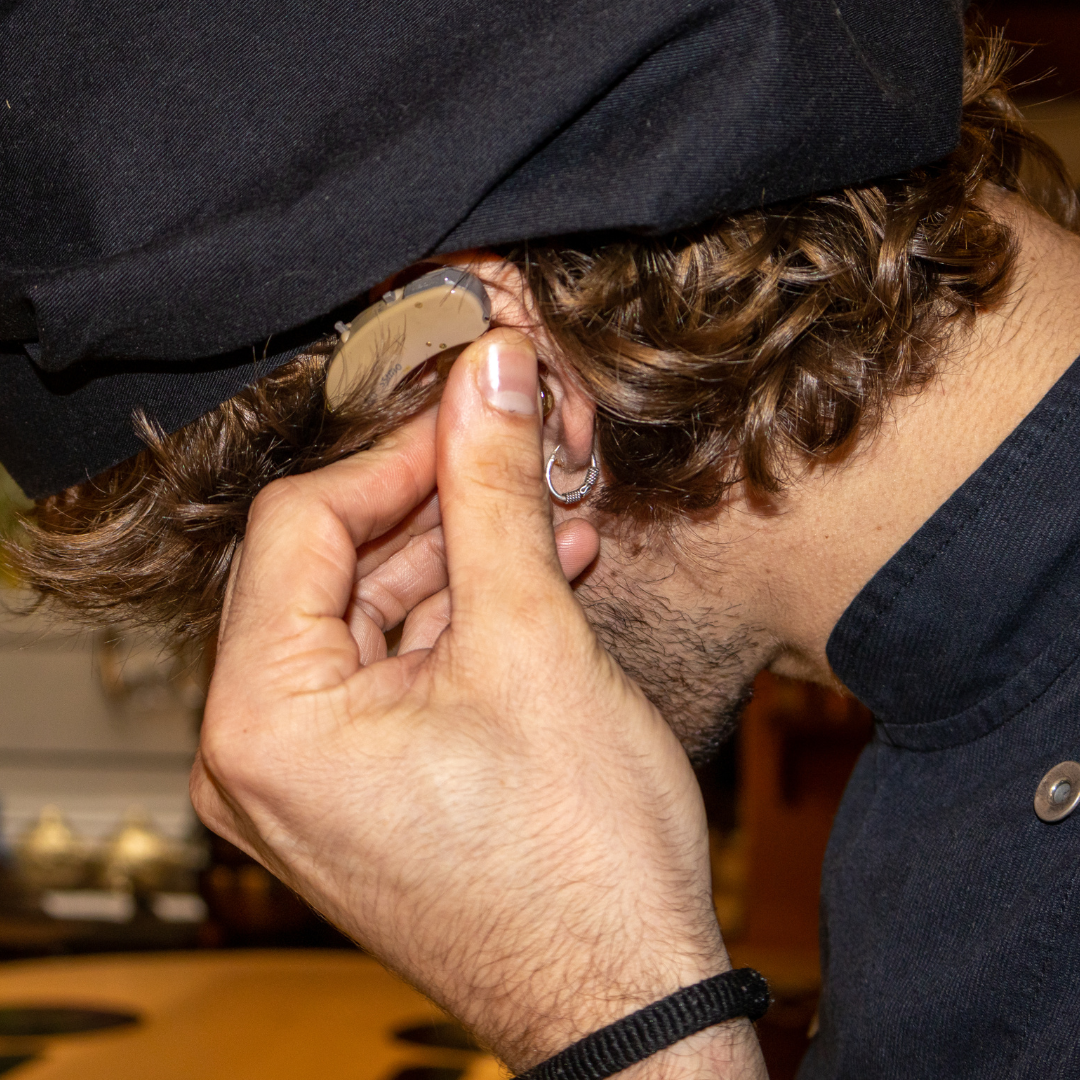
Following dinner conversations becomes challenging when high ambient noise interferes with your focus and hearing. Our audiology clinic conducts specialized testing to evaluate hearing in both quiet sound booths and noisy simulations to isolate the underlying cause. After diagnosing the source of your difficult hearing, we design targeted interventions tailored to your listening needs.
Why Everyday Hearing Fails in Busy, Noisy Restaurants
A quiet setting creates an optimal signal-to-noise ratio, ensuring the conversational partner’s voice rises cleanly above ambient sounds. Restaurants create the opposite situation. Multiple voices, music, kitchen noise, and reverberation overlap with speech, forcing the ears and brain to work harder to separate the person you want to hear.
Such difficulty frequently signals sensorineural high-frequency hearing loss, auditory processing dysfunction, or noise-induced cochlear damage. Factors including listening fatigue, poor dining lighting, acoustic distance, and wandering attention make comprehension significantly harder. Many individuals register normal audiometric thresholds on standard pure-tone screenings yet show profound deficits during speech-in-noise testing. Communication breakdowns in loud restaurants should be professionally assessed even if one-on-one listening feels uncompromised.
The Audiological Process for High-Frequency Hearing Loss
Our diagnostic process starts with a detailed case history reviewing problematic listening scenarios, occupational noise exposure, tinnitus, ototoxic medications, and familial genetics.
Clinical pure-tone audiometry identifies hearing threshold levels across various frequencies by delivering sounds through air and bone pathways. High-frequency loss often creates an audiogram pattern in which thresholds become poorer as pitches rise. Further clinical diagnostics feature tympanometry to evaluate eardrum and middle-ear mechanics as well as word-recognition testing for speech comprehension.
Because a quiet booth does not recreate a busy dining room, speech-in-noise testing can add valuable information. This diagnostic protocol measures your capacity to understand target words or sentences against progressively louder multi-talker babble. Combined, these clinical findings determine whether your symptoms stem from acoustic audibility, word clarity, central noise filtering, or multifactorial causes.
How Do Auditory Processing Disorders Affect Hearing in Adults?
A central auditory processing disorder disrupts the neurological transmission and cognitive interpretation of sound waves. While peripheral ears may register soft tones normally, the auditory cortex struggles to filter competing noise, resolve phonetic contrasts, or keep pace with rapid conversation. We first evaluate peripheral hearing and then determine whether an individualized auditory-processing test battery or referrals to other professionals are appropriate.
Behavioral Strategies for Hearing Clearly in Loud Venues
Small changes can improve the signal reaching your ears and provide clearer visual cues. Prior to dining, choose venues known for lower noise levels or schedule meals during quieter dining hours. Restaurants featuring plush booths, wall acoustic panels, heavy drapery, carpeting, and sound-dampening materials provide superior listening compared to open rooms with reflective surfaces.
In-venue communication guidelines:
- Request a table away from the kitchen, bar, speakers, and large groups.
- Situate yourself with a structural wall behind you to minimize distracting ambient noise from behind.
- Seat yourself facing conversation partners under clear, bright lighting to facilitate visual speechreading.
- Reduce physical spacing between yourself and companions to maximize direct speech perception.
- Orient your stronger ear toward the key person you want to follow in conversation.
- Request that companions rephrase misunderstandings using different words rather than repeating the same sentence.
- Confirm important details rather than pretending to understand.
- Take brief listening rests outside or in quiet hallways when mental fatigue emerges.
- Request that friends speak with crisp clarity rather than speeding through dialogue.
- Elevated yelling distorts auditory signals and seldom improves actual phonetic comprehension.
Assistive Listening Technologies for Noisy Environments
The best technology depends on the cause of the difficulty, the listening environment, and whether hearing loss is present. Prescription hearing aids fitted by an audiologist leverage directional microphone arrays, advanced digital noise reduction, and dedicated restaurant programs to focus on frontal speech while dampening background sound. Patients must uphold realistic expectations because modern amplification cannot strip out every ambient human voice completely.
A remote microphone can provide a stronger improvement in the signal-to-noise ratio. The microphone is placed near or worn by the speaker and sends that voice directly to compatible hearing aids or another receiver. This wireless transmission substantially diminishes the acoustic degradation caused by physical distance and ambient room noise.
Supplementary auditory solutions include:
- Multi-directional table microphones designed for small dinner gatherings
- Telecoils or hearing-loop systems in equipped venues
- Mobile device live-captioning programs and speech-to-text transcription software
- Consumer wireless earbuds or hearables featuring customizable assistive listening modes
- Sound-level meter applications and community-driven quiet dining guides
We evaluate these technological options, ensure full hardware compatibility, and instruct you on maximizing your selected system.
The Clinical Role of Audiologists in Managing Loud Environments
A thorough audiological evaluation expands the diagnostic scope well past simple quiet listening performance. We assess the specific acoustic settings, speaker dynamics, and volume levels that disrupt your hearing to administer targeted evaluations. Clinical evaluation commonly integrates pure-tone audiometric testing, middle-ear analysis, word recognition, and speech-in-noise measures. Advanced auditory-processing testing can be introduced whenever medical history and baseline assessments justify specialized evaluation.
Any sudden, asymmetric, or rapidly deteriorating hearing loss demands immediate medical evaluation by an ear, nose, and throat physician. Comprehensive clinical care targets the physiological roots of hearing difficulties rather than simply writing them off as bad restaurant acoustics.
Contact Us for a Hearing Evaluation Today
If restaurant conversations leave you guessing, withdrawing, or feeling exhausted, schedule a comprehensive hearing evaluation with us. Our specialists can introduce effective interventions to support your hearing in noisy environments via precision hearing aid fittings, assistive devices, or audiological rehabilitation.
Connect with us today to arrange your clinical visit and take the first step toward clearer, easier dining communication.
